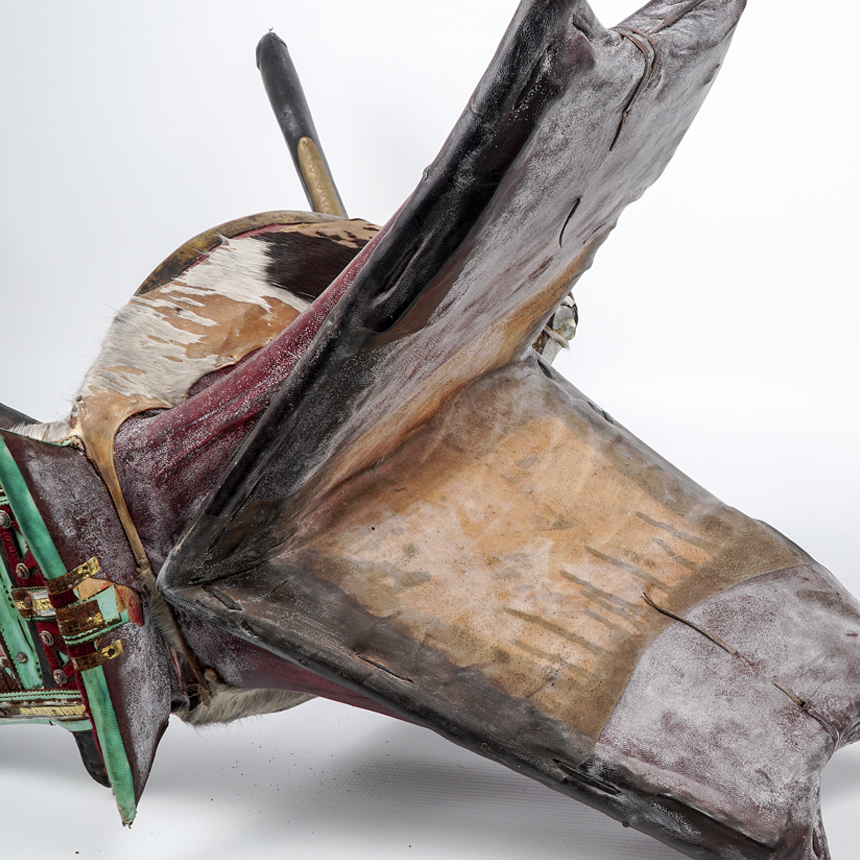
Camel saddle – MŻo/A/4048
The camel arrived on the Mediterranean coast of Africa from the Middle East around the first century B.C. Able to carry heavier loads and travel greater distances without water than horses or donkeys, camels were essential to the development of regular long-distance commerce across the desert in the seventh century. An adorned leather saddle such as this example is designed to fit in front of the camel’s hump on top of several saddle cloths, allowing the rider to rest his feet. The forked saddle horn between the rider’s legs could be used to steady himself. During the travel, the male rider sits cross-legged with his feet on the animal's neck.
There are three different forms of saddles: this example with its distinctive forked saddle horn and detailed leather decorations is the tamzak type.
Bibiliografia:
– Camel Saddle (hasło), [w:] www.metmuseum.org (strona Metropolitan Museum of Art); link: https://www.metmuseum.org/art/collection/search/760049 [dostęp: 31.08.2021]
–Saddle (hasło), [w:] www.africa.si.edu (strona Smithsonian National Museum of African Art); link: https://africa.si.edu/collections/view/objects/asitem/items$0040:3076 [dostęp: 30.08.2021].
----------------------------------------------------------------------------
The purchase is co-financed by the Ministry of Culture, National Heritage and Sport as part of the National Institute of Museums and Collections' own program "Expansion of museum collections".