Anthropomorphic masks – MŻo/A/3573, 3576
Origin:
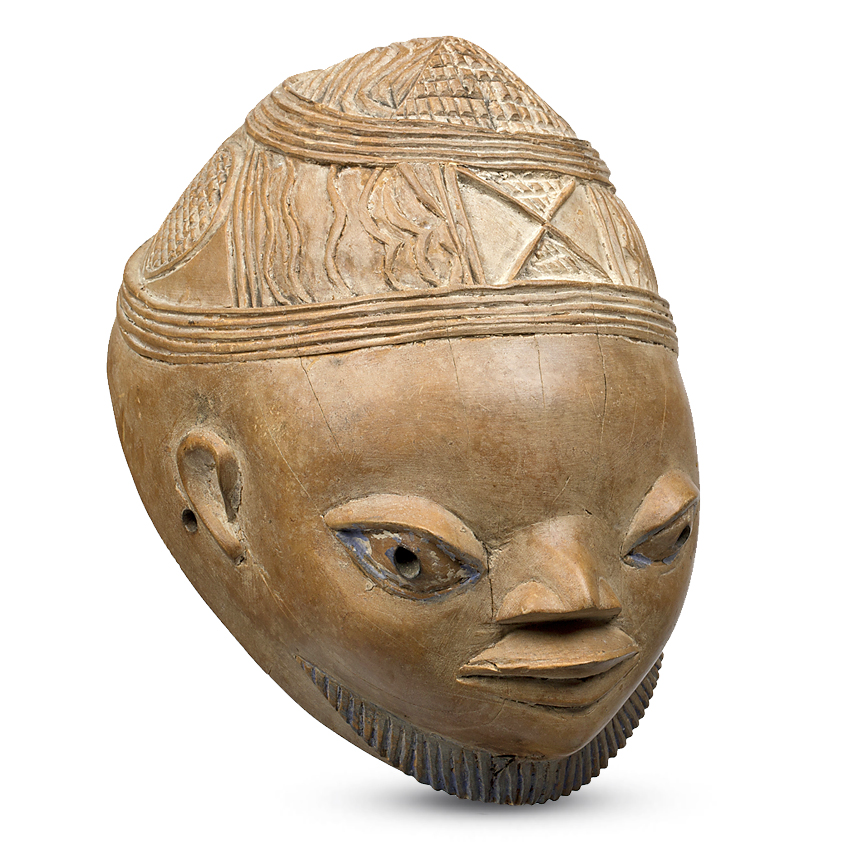
MŻo/A/3573 Yoruba (Nigeria, Benin)
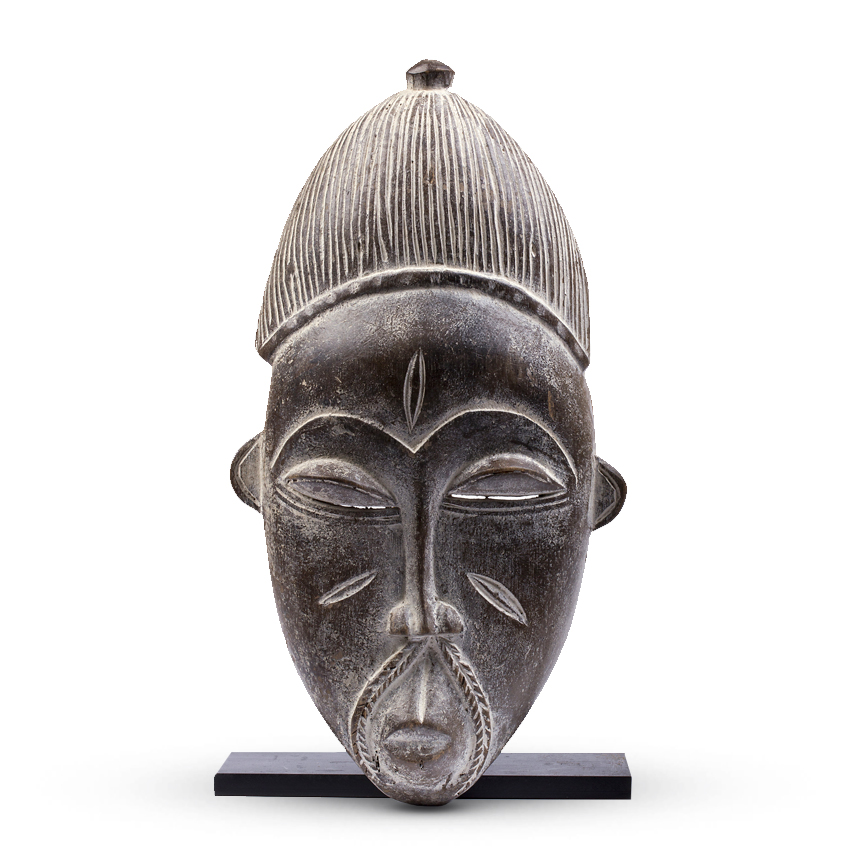
MŻo/A/3576 Ogoni? (Nigeria)
Dating:
MŻo/A/3573: second half of the 20th century
MŻo/A/3576: 1990s
Dimensions:
MŻo/A/3573 height 30,0 cm, width 20,0 cm, depth 16,0 cm
MŻo/A/3576 height 32,5 cm, width 18,5 cm, depth 9,0 cm
Material: wood
Techniques: carving
Acquired by:
MŻo/A/3573 Jacek Łapott, artisana, Abomej (Benin), 2001 r.
MŻo/A/3576 Jacek Łapott, artisana, Douala (Kamerun), 2005 r.
Description:
The Federal Republic of Nigeria is inhabited by 250 ethnic groups speaking 520 languages, 13 can be used officially and 12 are threatened with extinction [https://www.ethnologue.com/country/NG/]. It is a country with a strong ethnic diversity, and there is a clear division into the Christian south and the Muslim north.
The Yoruba people are the largest ethnic group in Nigeria, making up almost 21% of the population, they speak two groups of languages. Traditional occupations were farming and crafts (many Yoruba live in cities and trade today), they also cultivate traditional crafts (including weaving).
The presented mask is called gelede, from a secret men's society that uses the symbolic power of sculptures - masks to please women, to whom they attribute special spiritual power. The Gelede association is derived from the cultural myths of Yemoja, the mother of all living beings, who could not conceive children until she learned to dance with a wooden effigy on her head. The name Gelede comes from the chubby daughter of Yemoja, which is why the dance is closely related to fertility rites. Nevertheless, the ceremonies of the Gelede society serve a variety of functions in Yoruba society, including asking the deities for rain, cleansing the village of sickness, invoking spiritual help in times of war, and honoring the dead [https://www.maskmuseum.org/mask/yoruba-gelede-2/].
The Ogoni, like the Yoruba people, inhabit the southern part of Nigeria, the Niger Delta - the area inhabited by them is commonly called Ogoniland. Unlike the Yoruba (45 million), however, they are much less numerous (slightly over 2 million). A serious problem for their existence are the oil deposits located in their area. They drew attention to their problems with a massive public protest campaign against Shell Oil.
According to oral tradition, the Ogoni came to today's abodes from the former Ghanaian empire [http://www.101lasttribes.com/tribes/ogoni.html]. Linguistic calculations done by Kay Williamson place the Ogoni in the Niger Delta since before 15 BC, making them one of the oldest settlers in the eastern Niger Delta region. Radiocarbon dating taken from sites around Ogoniland and oral traditions from neighboring communities support this as well. The main sources of Ogoni's livelihoods are agriculture, cattle breeding and fishing, and they also produce palm oil and salt.
According to tradition, the Ogoni have eight types of wooden carvings, masks depicting women and men, and marionettes. Masks - as in many peoples - are an important attribute of secret societies, the most important of which is Amnikpo representing the strength and will of the spirits of the ancestors. Larger and more grotesque masks depict restless spirits and wild animals (zoomorphic masks). Mask dances perform important social functions, ranging from entertainment through punishment of the guilty, but above all they serve the worship of the gods [https://www.si.edu/object/siris_sil_805684].
Bibliography:
https://www.ethnologue.com/country/NG/, access 17.07.2023.
https://www.maskmuseum.org/mask/yoruba-gelede-2/, access 24.11.2020
https://www.si.edu/object/siris_sil_805684, access 17.07.2023.
http://www.101lasttribes.com/tribes/ogoni.html, access 17.07.2023.
Gromyko Anatolij, 1984, Maski i skultura Tropičeskoj Afriki, Moskva.
Edited by Lucjan Buchalik
----------------------------------------------------------------------------
The purchase is co-financed by the Ministry of Culture, National Heritage and Sport as part of the National Institute of Museums and Collections' own program "Expansion of museum collections".