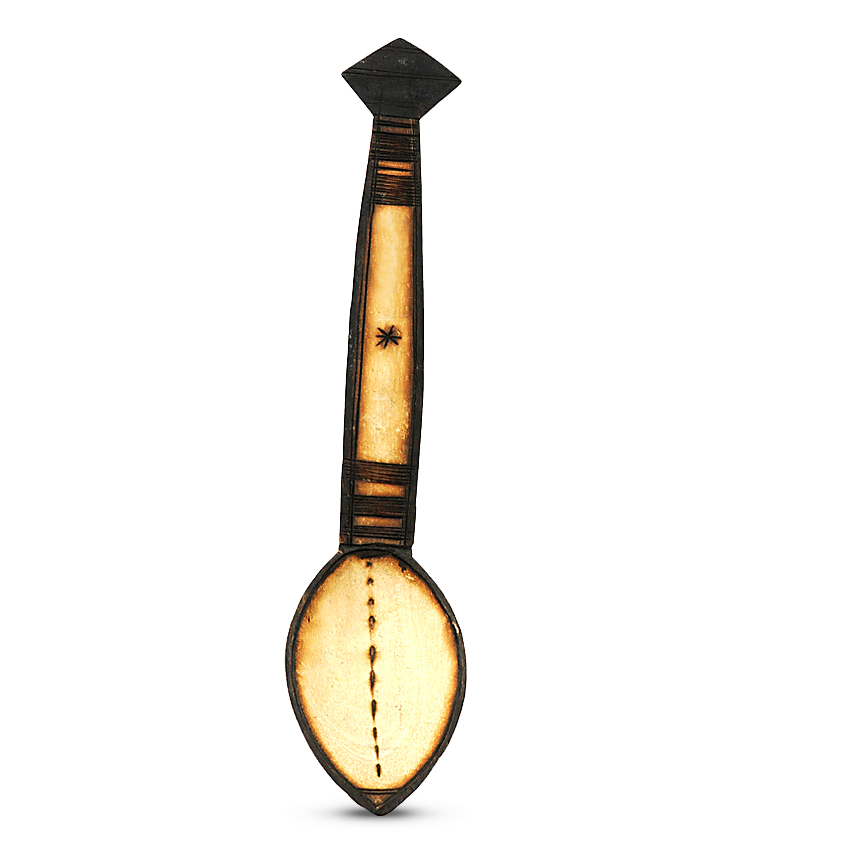
Spoons – MŻo/A/4061–4065
Origin: Tuareg
Local name: tesoukalt (in Tamashek)
Dating: 1990s
Dimensions:
MŻo/A/4061: length 22.2 cm, width 4.5 cm, depth 1.7 cm
MŻo/A/4062: length 21.6 cm, width 5.5 cm, depth 1.8 cm
MŻo/A/4063: length 23.0 cm, width 4.5 cm, depth 2.0 cm
MŻo/A/4064: length 23.6 cm, width 5.1 cm, depth 1.8 cm
MŻo/A/4065: length 23.1 cm, width 5.5 cm, depth 2.0 cm
Material: wood
Techniques: carving
Acquired by: Adam Rybiński, Tuareg camp in Timia, Aïr Upland (Niger)
Description:
There are many concepts about the origin of the Tuaregs. One of the legends, created in the 19th century, says that the Tuaregs are descendants of the Crusaders. According to that legend some of the knights taking part in the crusades left the Holy Land and went to they went to live in the desert. High temperatures caused them to give up metal armor and helmets and began to cover their heads with fabrics. Of course, such concepts should be approached with great caution.
The spoons are made of one piece of brown wood, with an elongated, oval scoop and a handle with a triangular decorative element. They were made by the Tuareg people from the Aïr Highlands in Niger in the 1990s, as evidenced by the characteristic shape. Spoons with signatures MŻo/A/4064-4065 are decorated pyroplastically [Rybiński 2015: 30].
Very good condition, no visible damage or conservation measures.
Spoons in all cultures are used to consume liquid and semi-liquid foods. In the case of the Tuareg, the spoons were used for milk-based dishes. Milk was the base of flour dishes with the consistency of a sauce. "It was also the basis of the often consumed milk soup, which also included millet flour, cheese, powdered dates and pepper" [Rybiński 1999: 104]. The shape of the spoons depends on the region [Gabus 1958: 263-269]. The simplest shape seems to have spoons from Ahaggaru (Algeria), which can even be bought at markets in the kingdom of Lurum (northern part of Burkina Faso).
Milk was an extremely important product obtained from goats, sheep and camels, and along with millet and dates, it was the basis of the diet of the Tuareg Kel Ahaggar. To this day, milk is the favorite food and drink of the Tuareg, giving, as they believe, strength and health. A Tuareg proverb says: "Water is the soul, milk gives us life." And when the Kel Ahaggar state that they "have lost the taste of milk", it does not mean that they did not drink milk, but that they had lost the joy of life at all [Gast 1968: 139].
Bibliography
Gabus Jean, 1958, Au Sahara. Arts et symboles, Neuchâtel: A la Baconnière.
Gast Marceau, 1968, Allimentation des population de l’Ahaggar. Étude ethnographique, Paris.
Nicolaisen Johannes, 1963, Ecology and Culture of the Pastoral Tuareg with Particular Reference to the Tuareg of Ahaggar and Ayr, Copenhagen: The National Museum of Copenhagen.
Rybiński Adam, 1999, Tuaregowie z Sahary. Tradycyjna kultura Tuaregów Kel Ahaggar na przełomie XIX i XX wieku, Warsaw: Wydawnictwa Akademickie Dialog.
Rybiński Adam, information provided during interviews (2020-2022).
Edited by Lucjan Buchalik
----------------------------------------------------------------------------
The purchase is co-financed by the Ministry of Culture, National Heritage and Sport as part of the National Institute of Museums and Collections' own program "Expansion of museum collections".