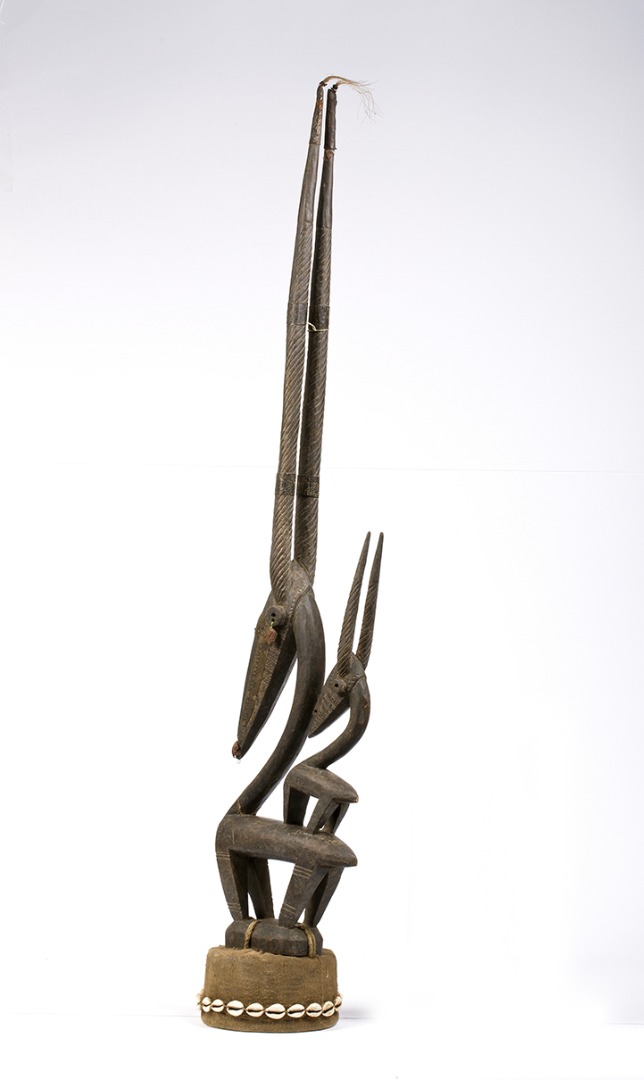
TJI-WARA Antelope Mask – MŻo/A/3592
Origin: Mali, Bambara ethnic group (or: Bamana)
Dating: 2nd half of the 20th century
Signature: MŻo/A/3592
Description:
A zoomorphic mask depicting a symbolic image of two antelopes mounted on a headgear made of woven vegetable fibres covered with a cloth and decorated with kauri shells. Tji-wara (chi-wara) - a type of helmet mask made by the agricultural people of Bamana (Bambara) people, dominant in the central and southern part of the Republic of Mali. The decorative top of the mask (the so-called sogoni-kun) shows an antelope symbolizing the supernatural being that cultivated the land, descendant of the first created woman and the serpent. The mask consists of a stylized antelope figurine mounted on a woven base worn over the head and a costume. Traditionally, it consisted of a hood made of red fabric or black dyed raffia fibres, a cap and a tunic covered with black fibres. Today, however, dancers more and more often wear white cotton trousers and T-shirts, and their faces are covered with factory-made fabrics sometimes decorated with kauri shells.
Tji-wara masks are associated with agrarian cults; according to Bamana mythology, the antelope came down from heaven and taught them how to cultivate the land. The figures on the top of the mask can represent both a male antelope (bigger than the female, with a large fringe and slightly curved horns) and a female (with a little antelope on her back, usually with straight, pointed horns). Rites with these masks take place before important field work, such as sowing or harvesting. During the ceremony, both types of masks are used and they dance in pairs (male and female antelope). The dancers participating in it belong to a similar age group and their movements imitate the behaviour characteristic of antelopes. The term tji-wara can be interpreted in many different ways: The Bamana people translate it as "the perfect farmer", but literally the name means "wild farm animal" - the word "tji" means, among other things, "cultivating the land", and "wara" refers to wild animals. Tji-wara masks are one of the most famous objects of African art. Nowadays, the upper, wooden part of the mask is a popular souvenir, eagerly bought by tourists, and many examples of it can be found in private collections and museums around the world.
The purchase of the masks collection was subsidized by the National Institute for Museums and Public Collections.
Literature:
Bargna 2000: 135; Bravmann 1999: 501; Colleyn 2009: 13, 27; Delange 1967; Guennguez s. a.; 208-213; Hahner and others 2007: pl. 1-3; Leuzinger 1960; Prądzyńska 2014: 505.